

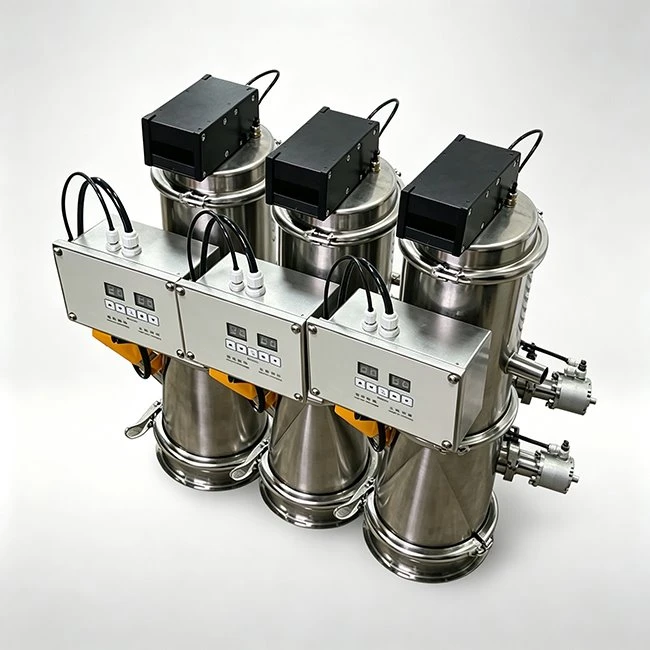
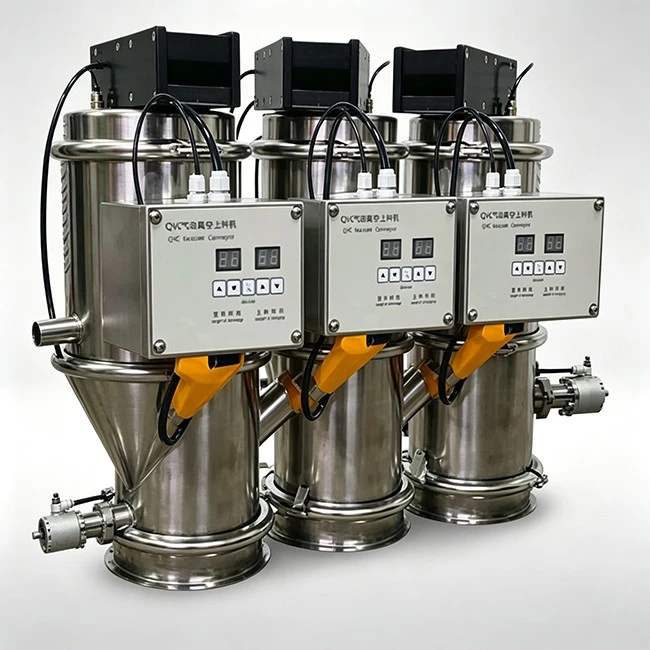
Nanjing Huozao Machinery Technology Co., Ltd. is one of the leading manufacturers and suppliers of explosion-proof vacuum feeder in China. With abundant experience, we are committed to providing high quality equipment made in China with competitive price. Welcome to wholesale customized explosion-proof vacuum feeder from our factory.
Equipment Structural Configuration
Safe Vacuum Power Source
Two vacuum supply modes are optional to match different safety grades and process conditions. Pneumatic vacuum generators can be deployed to reduce on-site electrical equipment, suitable for high-standard explosion-proof workshops. When large conveying volume and long-distance lifting are required, matched explosion-proof vacuum pumps are adopted. The protection level of electric components strictly complies with on-site hazardous area safety specifications.
Static Grounding Control Structure
High-speed friction between powder/granule materials and pipelines easily generates static charge during pneumatic conveying. The whole Explosion-proof Vacuum Feeder is equipped with conductive hoses, equipotential bonding parts and fixed grounding points, forming a complete static dissipation loop. This structural design avoids static charge accumulation and eliminates electrostatic discharge risks in combustible dust environments. All grounding structures are configured and inspected as part of the complete system installation.
Fully Enclosed Material Conveying Path
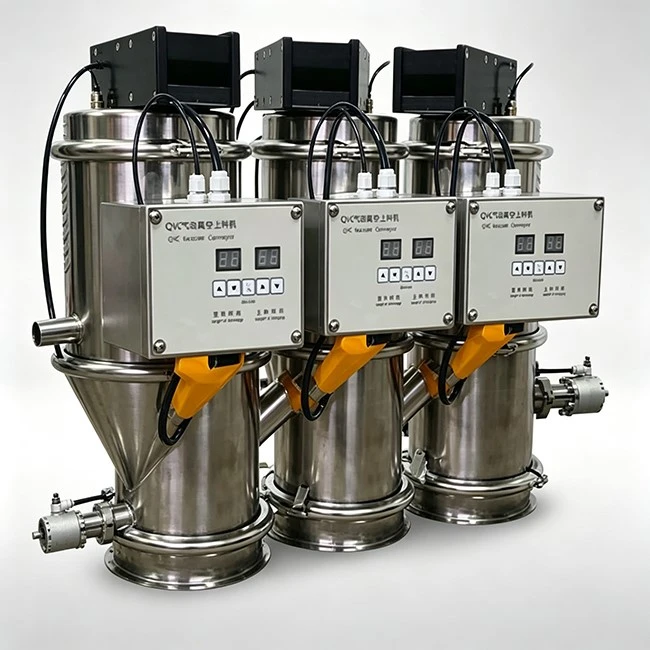
The entire material conveying process is completed through sealed pipelines and vacuum hoppers, with no open material exposure. This structure effectively controls dust overflow, prevents material contamination, and improves workshop cleanliness. The integrated closed pipeline design supports seamless docking with closed mixers, reactors and other automated equipment, facilitating integrated automated production lines.
Customizable Conveying Combination
Core specifications including pipe diameter, vacuum power, hopper volume and discharge structure are adjustable according to actual material properties and working conditions. Conveying distance and vertical lifting height are key indicators for vacuum capacity matching. For materials with poor fluidity that are prone to bridging and material stagnation, auxiliary feeding structures can be added to stabilize continuous feeding operation.
Working Principle
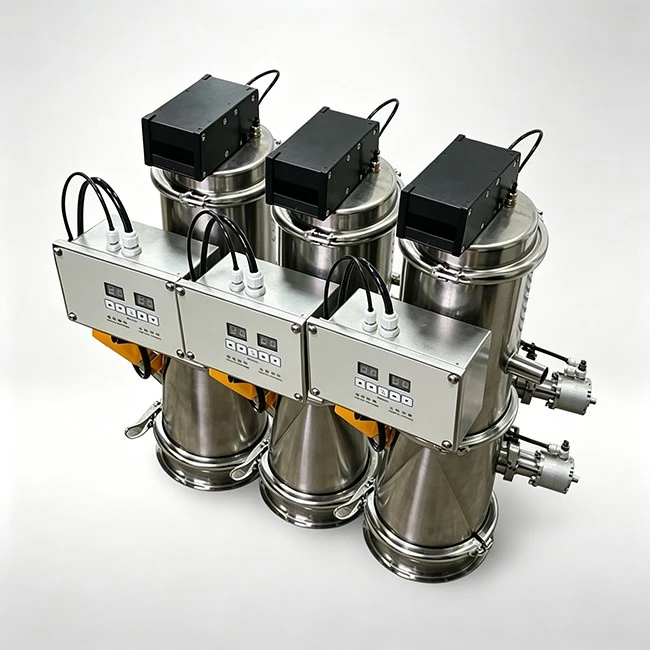
The Explosion-proof Vacuum Feeder unit stably generates negative pressure inside the hopper and sealed pipelines. Under pressure difference, materials are steadily sucked from the storage container into the vacuum hopper. After completing material suction, the suction cycle stops automatically, the bottom discharge valve opens, and materials fall into downstream processing equipment by gravity.
After discharging is finished, the valve closes, and the equipment starts the next cyclic conveying process. Filter cleaning, discharging time and cycle switching are automatically controlled by the system. For flammable and explosive working conditions, the system relies on grounding and bonding structures to control static electricity. All electrical and vacuum components adopt explosion-proof configurations matching the hazardous area level. In high-risk scenarios, an inert gas protection system can be equipped for auxiliary safety protection.
Equipment Selection Guidelines
Model and configuration selection needs to combine material characteristics and on-site installation environment comprehensively, instead of relying on single parameters.
Material Characteristics: Particle size, bulk density, moisture content and fluidity directly affect conveying stability. Abrasive, fragile or bridge-prone materials require targeted optimization of pipeline structure, hopper design and feeding mode to adapt to special material attributes.
Conveying Stroke: Horizontal conveying distance and vertical lifting height determine the required vacuum degree and air volume. Long-distance and high-lift working conditions usually need larger pipe diameters and higher-power vacuum equipment to guarantee stable feeding.
Production Capacity Demand: Hourly conveying output serves as the core basis for selecting hopper volume, pipeline specification and vacuum source. All catalogue capacity data is for reference only; actual operating performance fluctuates with material status and on-site working conditions.
Hazardous Area Classification: For environments with combustible dust and flammable materials, the explosion-proof grade must match the site hazard level. Supporting configurations such as explosion-proof electrical parts, static grounding systems and conductive pipelines are determined according to material explosion parameters and local safety standards. The final system scheme is confirmed based on material safety data, dust explosion characteristics and on-site specification requirements.
Technical Specifications
The selection of an Explosion-proof Vacuum Feeder also follows our previous discussion on the principle of "considering the material type, production capacity, and required distance." Below are examples of two models with clearly defined specifications:
|
Model |
Power of motor |
Conveyance capacity (Reference) |
Explosion-proof applicable environments |
|
ZKS-1-7 |
1.5 - 7.5KW |
1000 - 2000 (KG/H) |
Gas hazard: IIA/IIB; T staging: T1–T4; Dust hazard: A21/A22 |
|
ZKS-7-15 |
7.5 - 15 KW |
2000 - 4000 (KG/H) |
Gas hazard: IIA/IIB; T staging: T1–T4; Dust hazard: A21/A22 |
|
Pneumatic (powerless) |
not have |
Can reach 2000 |
Inherently safe explosion-proof design, with no electrical ignition sources. |
Applications
This Explosion-proof Vacuum Feeder is applicable to automated closed feeding scenarios for flammable powders and granular materials. It is widely matched with storage containers, mixers, reactors and packaging equipment to realize safe and unmanned material conveying.
Typical applicable industries and materials include fine chemical raw powders, pharmaceutical intermediates and raw materials, new energy functional powders, pesticide and agrochemical materials, coatings, resins and various flammable auxiliary additives. The Explosion-proof Vacuum Feeder is mainly used for production links requiring dust control, automatic feeding and standardized explosion-proof protection.
Hot Tags: explosion-proof vacuum feeder, China explosion-proof vacuum feeder manufacturers, suppliers, factory


