

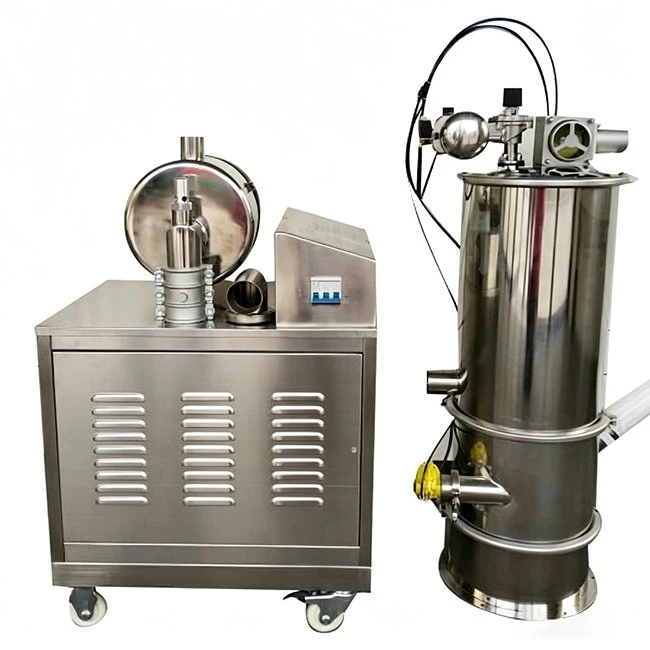
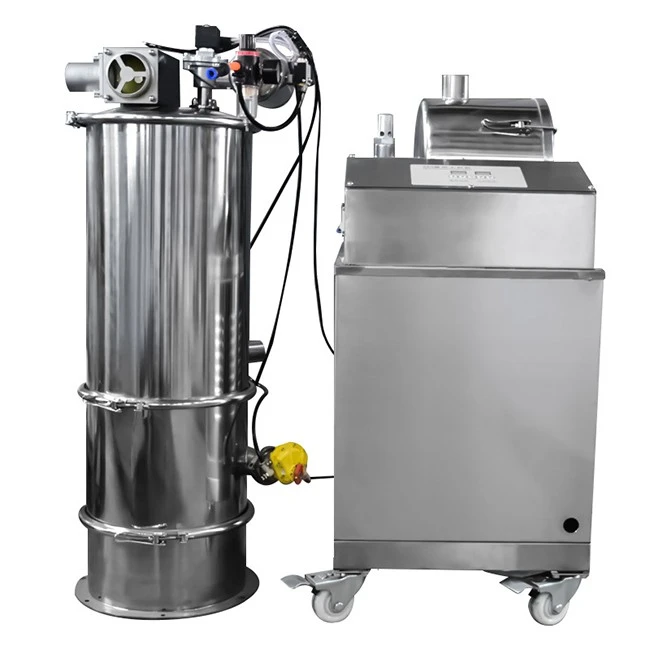
Nanjing Huozao Machinery Technology Co., Ltd. is one of the leading manufacturers and suppliers of particle vacuum feeder in China. With abundant experience, we are committed to providing high quality equipment made in China with competitive price. Welcome to wholesale customized particle vacuum feeder from our factory.
Design Differences Between Granule and Particle Vacuum Feeder
Granular materials with particle size between 1 mm and 10 mm require pipelines with sufficient inner diameter to ensure smooth passing. Corners, valve positions and narrow pipe sections are the most common blocking points. Reasonable pipe diameter matching, optimized suction port shape and enlarged discharge openings effectively reduce material jamming. Hard or high-abrasive granules also demand targeted pipe wall thickness and special pipe materials, avoiding pipeline thinning and damage caused by long-term friction.
Powder materials below 1 mm present entirely different conveying characteristics. Fine particles easily penetrate conventional filter layers and adhere to filter surfaces, causing airflow blockage and capacity attenuation. Equipped with PTFE membrane filter elements and stable back-blow cleaning systems, the Particle Vacuum Feeder maintains continuous filter permeability and avoids frequent shutdown cleaning. In mixed materials with inconsistent particle size or density, unreasonable airflow speed and pipeline layout easily cause component segregation. On-site conveying parameters must match material formulas to ensure uniform ingredient ratio before and after transportation.
Working Characteristics of Granular Vacuum Conveying
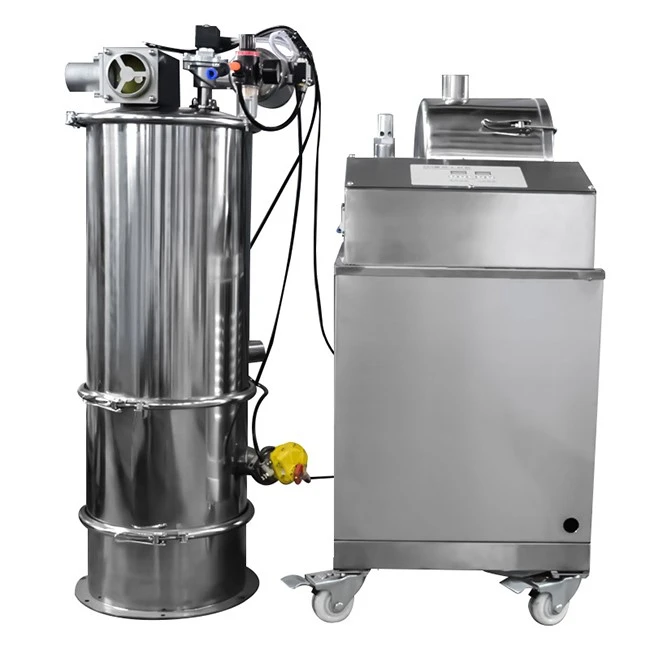
Fully enclosed pipeline structure isolates granular materials from external environments, effectively reducing material leakage and workshop dust. This structural advantage adapts to standardized production conditions in food, pharmaceutical and fine chemical industries.
Most granular conveying systems adopt pneumatic control, with vacuum power units installed independently of material flow paths. Users cannot simply judge system safety based on pneumatic conveying form. For combustible and explosion-prone granular materials, workshop hazard classification and material explosion parameters must be fully evaluated. Supporting configurations including static grounding, equipotential bonding, explosion-proof electrical components and inert gas protection should be installed according to actual working conditions. Final system configuration is determined by on-site safety standards and material properties.
Actual Conveying Capacity Description
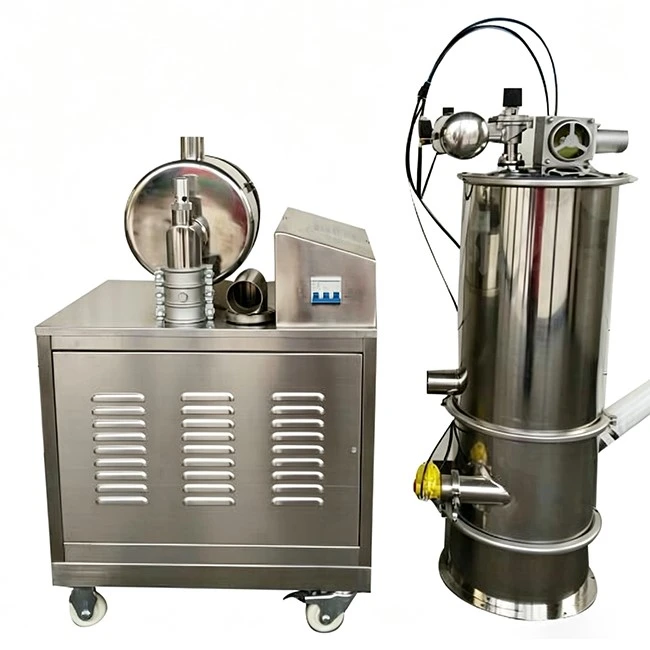
Different vacuum conveyor models deliver variable conveying performance. Particle Vacuum Feeder output is not determined solely by motor power. Multiple on-site factors affect actual throughput, including vacuum degree, pipe diameter, material density, particle shape, horizontal conveying distance, vertical lifting height and feeding stability.
All catalogue capacity data is for reference only and cannot be regarded as fixed production indicators. Before model confirmation, manufacturers need to collect complete material parameters and working condition information. Key evaluation items cover material application type, particle distribution, bulk density, hardness, abrasion resistance, flowability, conveying stroke, lifting height and hourly output requirements. Special material characteristics such as fragility, stickiness and segregation tendency also need detailed confirmation. For complex materials with unstable conveying performance, actual material testing is the most reliable way to verify final capacity.
Key Model Selection Criteria
Particle Size and Hardness Matching
Conventional 1–10 mm granules adapt to standard pipelines with inner diameter from 50 mm to 76 mm. Exact pipe size is calculated based on actual output and material fluidity. Large particles or small lumps within 10–20 mm need enlarged pipelines of 89 mm to 108 mm, matched with reinforced discharge structures. For high-hardness and high-abrasive materials such as mineral particles, wear-resistant liners or thickened pipe walls are required to extend equipment service life.
Bulk Density and Flow Adaptation
High-density granular materials impose higher load on vacuum systems. Model selection cannot rely only on motor power parameters. Professional evaluation of vacuum degree and air volume is necessary. Roots vacuum pumps are preferred for high-density materials and long-distance high-lift working conditions to ensure stable suction power.
Poor-flowing granules easily cause bridging and feeding stagnation at suction points. Auxiliary structures such as vibrating hoppers and auxiliary agitators can be configured to stabilize continuous feeding.
Hygienic Industry Configuration
Food and pharmaceutical granular materials require strict sanitary control. 316L stainless steel is widely used for all material-contact parts. Polished inner walls, smooth transition structures and zero-dead-angle design simplify daily cleaning and rapid formula switching. Users should confirm whether the overall Particle Vacuum Feeder configuration meets GMP and FDA specifications, instead of judging sanitary standards merely by stainless steel materials.
Explosion-Proof Safety Configuration
Materials that can produce combustible dust need independent safety assessment. According to material explosion characteristics and workshop hazardous area level, the system can be equipped with conductive pipelines, static grounding systems, explosion-proof electrical accessories and nitrogen protection devices. Safety grades and supporting facilities must be customized based on actual conditions. It is not feasible to apply unified explosion-proof standards for all flammable materials.
Required Parameters for Quotation and Customization
Vacuum conveyor selection must combine comprehensive working conditions rather than single particle size data. Granules with the same particle size but different density, hardness and surface properties deliver completely different conveying effects.
To obtain accurate model selection and reliable technical solutions, users need to provide detailed information including material name, particle size range, bulk density, flowability, conveying distance, lifting height and required hourly output. Special material attributes such as viscosity, fragility, abrasiveness and segregation risk also need clear description. Manufacturers configure targeted pipe diameter, suction port structure, discharge valve type, filter specification and vacuum power unit based on these parameters. For special materials and high-precision production requirements, sample testing is recommended to verify final operating performance.
Hot Tags: particle vacuum feeder, China particle vacuum feeder manufacturers, suppliers, factory


