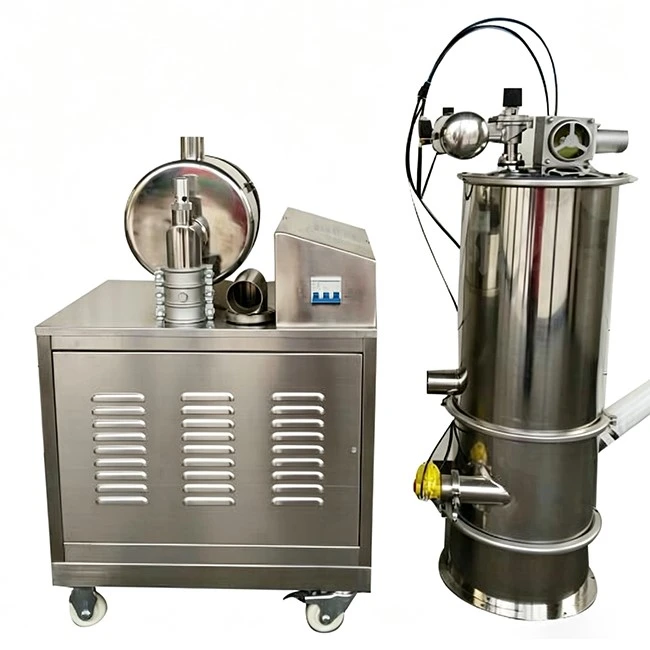
Vacuum feeders utilize the principle of negative pressure pneumatic conveying to achieve automated dust-free conveying of powder and granular materials. Their operation is based on a cyclic process of "negative pressure adsorption - filtration separation - positive pressure unloading".
During the vacuum generation and adsorption stage, a vacuum pump (or Roots blower) generates negative pressure (typically -0.4~-0.6 bar) within the conveying pipeline. Under the influence of the pressure difference, the material is drawn into the conveying pipeline from the suction port.
After the gas-material mixture enters the filter chamber, the filter element (materials such as polyester fiber, sintered metal, or PTFE) blocks the material, and clean air is discharged. The material accumulated on the surface of the filter element is automatically cleaned by pulse backflushing (instantaneous compressed air jetting) to maintain permeability [2]. Some models have a backflushing cleaning component that can backflush the bottom of the filter element, and the storage chamber remains under negative pressure during backflushing.
During the unloading stage, the vacuum pump stops working, the butterfly valve at the bottom of the hopper opens, and the material falls into the downstream equipment by gravity. Continuous automated feeding is achieved by setting the material feeding-unloading cycle (typically 10-60 seconds/cycle) using a PLC or time relay.
For models with level sensor control, the material in the receiving equipment hopper can be automatically fed via the level sensor; feeding stops when the material level is above a certain position and automatically restarts when it is below a certain position.